Blog
Online insight communities: time to wake up the sleeping beauty
How the true beauty of online research communities lies in its longitudinal character.

Angie Deceuninck
12 July 2023
3 min read
Online insight communities enable brands to build an ongoing relationship with research participants, generating deeper insights and supporting iterative learning over time.
As chatbots and AI-powered interviews surge in popularity, online research communities continue to play a critical role. In fact, the 2023 GRIT Insights Practice Report shows that the use of online research communities has grown by 13% among buyer-side insights professionals. Communities are not just a popular tool – they’re becoming a go-to method for tackling a wide range of business questions.
Your R&D team has a question on sustainable packaging? Marketing needs to know which product claim resonates best? Or what about testing a range of new product features? Online research communities are a great way to gather agile consumer feedback that helps you make better decisions.
But here’s the catch: if you’re only using your community for an endless stream of often disconnected ad hoc projects, you’re not using it to its full potential. You risk turning your community into a “sleeping beauty” – missing out on the deeper, strategic insights it could deliver.
The true beauty of online insight communities, compared with traditional research methods, is their ability to engage and collaborate with members over a longer period of time. This creates opportunities for longitudinal insights and iterative learning.
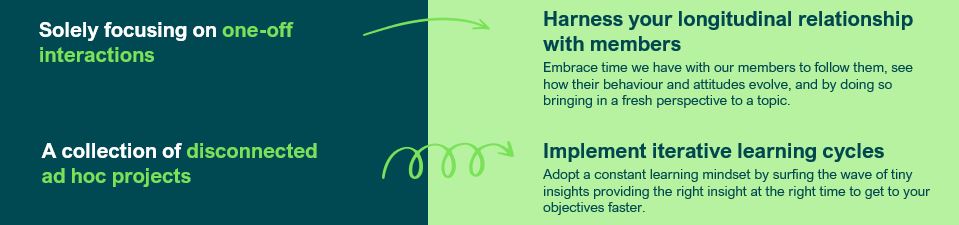
The power of time: harnessing the longitudinal relationship with members
Setting up a community for a longer period allows you to engage in a continuous dialogue with people who matter to your brand. This gives you a rare opportunity to immerse yourself in their lives, uncovering deep-seated habits, unmet needs and hidden frictions.
You can also observe how behaviours and attitudes evolve, gathering longitudinal insights along the way.
Take our work with a confectionery client in China, for example. We introduced their new product to community members and tracked their experiences over three months. This window allowed us to see how they incorporated the product into daily life, the habits it inspired and what they did once they finished the product.
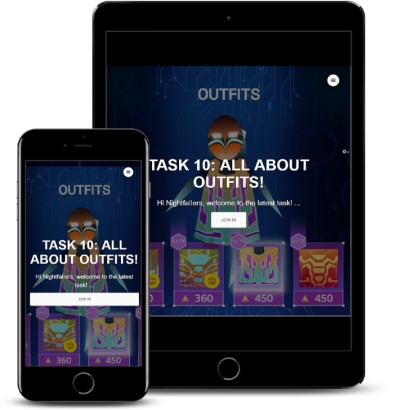
Another example is how young gamers helped the BBC co-design the game Nightfall. In the online research community, the “Nightfall Hub”, we engaged with 8-to-14-year-olds over a 12-week period.
This allowed us to explore their gaming habits and the Nightfall user experience, as well as gather feedback on specific aspects of the game over time. Unlike a traditional lab study, this community gave BBC a window into how children interacted with the game over time, uncovering the learning curve and nuances of gameplay that only emerge after repeated use.
Surfing the wave of tiny insights: embracing iterative learning cycles
Moving away from the traditional ad hoc research mindset means that every outcome can serve as the starting point for the next phase. This involves adopting a constant learning mindset, resulting in a more refined and holistic understanding.
Philips embraces the practice of Continuous Learning through its always-on online community, “My Living Square”. The idea is that human understanding is at the heart of proposition development. Continuous Learning leverages multiple learning loops with distinct objectives. It’s an ongoing cycle of observing, reflecting and creating. Since every learning loop is different, the versatility of “My Living Square” allows Philips to interact with people anytime, anywhere and in different ways. Activities vary widely – from pinpointing compliance barriers and refining UX to video tasks where parents interview children about exciting new concepts. The Continuous Learning approach enables the Philips teams to build on their successes and learn from their failures along the way.
Or look at how we connected Bloomingdale’s with millennials in a seven-month iterative collaboration to keep a finger on the pulse while the brand was developing its new beauty mall counter. The iterative approach provided Bloomingdale’s with the right insight at the right time – from generating insights and understanding consumer expectations for beauty shopping to refining concepts and fine-tuning the in-store experience. This collaboration led to the creation of Glowhaus, a beauty experience worlds apart from the traditional department store counter.
Are you ready to wake up your sleeping beauty? Next time all kinds of ad hoc questions come your way, think about how you could combine them into a single, strategic conversation to truly unlock the power of your community. Longer engagement means deeper insights, uncovering changes in behaviour and evolving needs over time. It’s not just research; it’s a continuous story, revealing the insights that truly drive smarter decisions.
What makes insight communities different?
The longitudinal nature of an insight community creates several advantages over more one-off research approaches:
- Continuous engagement: build an ongoing relationship with community members rather than starting from scratch for every project.
- Deeper understanding: observe changing behaviours, attitudes and needs over time.
- Iterative learning: use one research activity to inform the next.
- Agility: respond to emerging business questions without launching an entirely new research project.
- Context: understand not only what people think, but how their experiences evolve in real life.
The value lies in connecting these individual moments of research into a bigger picture.
1. How do insight communities differ from online panels?
Online panels typically provide access to a larger pool of participants for individual research studies. Insight communities involve a more engaged group of members who participate in (ongoing) research activities and (could) build familiarity with the brand, category or research topic over time.
2. How do you ensure data quality in insight communities?
Data quality starts with recruiting the right participants and maintaining active engagement. Clear research activities, thoughtful moderation and a mix of methods can help generate richer and more reliable insights.
3. How do you recruit members for an insight community?
Recruitment starts with defining the people who can best contribute to the research objectives. Members can be recruited through existing panels, specialist recruitment partners, customer databases or other relevant sources, depending on the audience.
4. How do you measure ROI from an insight community?
ROI can be assessed through the business impact of the insights generated, such as how research informs innovation, product development, marketing or customer experience decisions. The value also comes from the efficiencies created by having an engaged community that can support multiple research activities over time.