Case
Rethinking mobility in Sydney: Uber’s One Less Car experiment
Through a real-world experiment including an online insight community, we explored what it takes for Sydneysiders to give up a car, helping Uber shape its multimodal transport strategy.
The challenge
Transportation company Uber is at a turning point. Rideshare growth in Australia is slowing and car ownership is deeply embedded. Many households have more than one vehicle. Uber wanted to explore what it will take to help Australians break the “one adult one car mentality”. The question was simple but bold: what happens if one car disappears? This curiosity sparked the ‘One Less Car’ initiative, designed to uncover how Uber could support Australians in rethinking car use.
The solution
In partnership with Transport for NSW and behavioural science experts, we launched a real-world experiment asking Sydneysiders to give up their car for a month and explore how Uber’s transport solutions could support them.
1. Kick-off
We began by synthesising existing knowledge on mobility behaviours in Sydney, using AI-powered analysis tools, desk research and a scoping survey. In an ideation workshop with Uber, Transport for NSW and behavioural experts, we identified pain points and opportunities. It became clear that one solution wouldn’t be enough, people needed a mix of tools and incentives to enable lasting behavioural change.
2. Experiment at scale
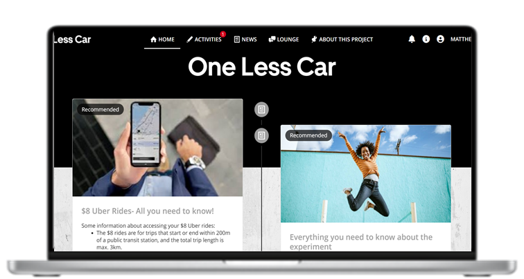
From this, Uber co-created three tailored bundles, combining their services with public transport credits and lifestyle tools. We recruited 900 Sydneysiders to give up their car for a month, capturing behavioural change through daily and weekly quant surveys. Alongside this, 80 participants documented their journey in an online insight community through video diaries, photo and storytelling.
3. Activate & socialise
We brought the work to life for Uber through an executive showcase, blending strategic reporting, behavioural insight and rich participant content. A highlight was a live Q&A session where community participants shared their stories directly with Uber’s leadership team.
The impact
The ‘One Less Car’ initiative challenged the deeply held belief that Australians would never give up their cars. Results exceeded expectations: among 500 tracked participants, private car use dropped 60%, proving behavioural change is possible at scale.
The trial revealed an untapped opportunity: many people are ready to rethink how they move, if they are given the right tools and support.
Insights from the project have shaped a new bundling strategy, positioning Uber as part of multimodal transport in Sydney, not just a point-to-point service. Uber is now preparing a second phase of product testing and is using the findings to build a business case for scaling this approach, potentially reshaping how people think about mobility beyond car ownership.
This project received the Best Paper Award at the ESOMAR APAC 2026 Conference in Tokyo.

“Our goal is to make it easier for people to live without a car. By providing convenient and affordable alternatives, we can help cities become greener and more liveable.”
Ready to do what matters?
Let’s connect!