Blog
Beyond the buzz: understanding the AI revolution
Why AI needs to be handled with care to avoid artificial stupidity.

Annelies Verhaeghe
19 July 2023
5 min read
This blog explores the opportunities and risks of generative AI, including its impact on market research, business decision-making and insight generation, while explaining why human expertise remains essential when using AI tools effectively.
AI is everywhere. OpenAI launched the AI chatbot ChatGPT last November, Microsoft introduced its AI-powered Bing search engine in February, Google launched ‘Bard’ in March, and also Meta responded, revealing its new AI image generation model ‘CM3leon’ last week. The idea is not new, in fact AI has been around since the early 1950s. What is new is the breakthrough of generative AI. This type of AI can learn from past experiences, remember context and make decisions based on that knowledge. In other words, when prompted with the right questions and commands, it can generate new, unique output. So what’s the value, potential drawbacks, but also business opportunities of this AI revolution?
Generative AI: a thinking and creating machine?
Since the 1950s AI has been making its way into almost every aspect of our lives. From the personalised content you see on TikTok and Instagram, to product recommendations on Amazon, or the voice-controlled personal assistant that drives your smart home devices.
But it’s generative AI that is the true game changer with an unseen adoption rate. ChatGPT, for example, crossed the one million user mark in just five days after it was made public. In comparison, Netflix took 3,5 years, Facebook 10 months and Instagram 5 months.
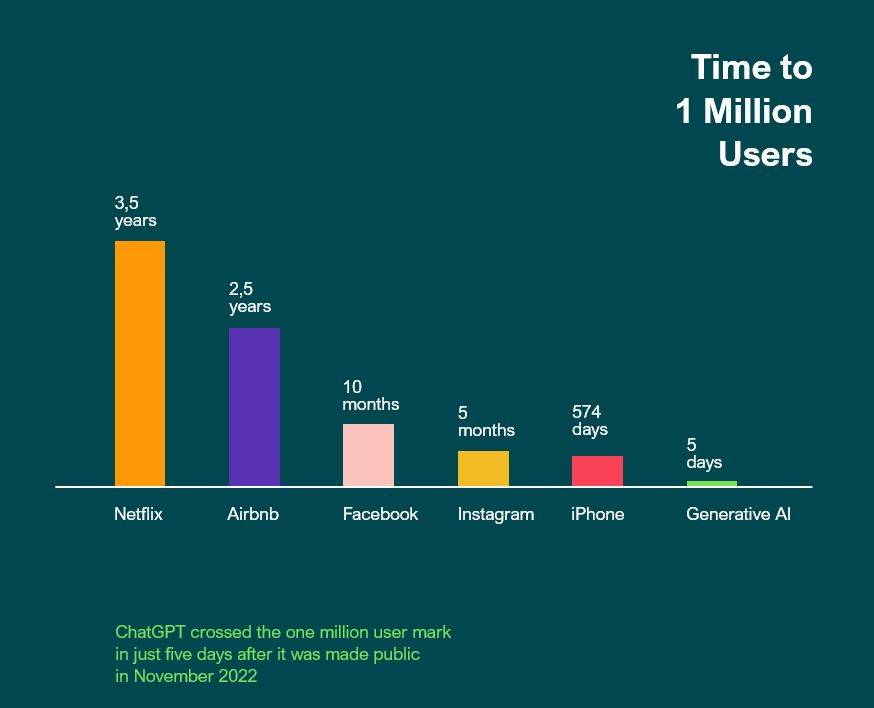
Generative AI models, such as ChatGPT and Bard, are rightly generating a lot of excitement. They are based on Natural Language Processing (NLP) which enables them to understand and generate human language as well as remember past conversations. Combine this with a dialogue interface and you get a very ‘human-like’ experience when interacting with an AI chatbot. The system can answer almost every question on any subject, hold conversations, and share opinions in real-time. Especially since the machine learns and improves with more interactions, and remembers this information in follow-up conversations, it almost seems like it thinks and creates by itself.
The dark side of AI
Generative AI systems are only as smart as the data they have been trained on. Since these chatbots rely on ‘older’ data, they cannot answer any question linked to recent events. For ChatGPT this means online content created up until late 2021. If you ask the tool ‘Who reins the United Kingdom?’, you get the below response.
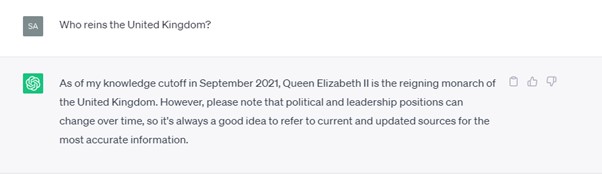
The systems are not only trained on ‘older’ data, but also on data that lacks diversity, resulting in inappropriate or even offensive responses. Several studies show that ChatGPT is biased against certain races and generates misinformation about certain ethnic and social groups. OpenAI’s CEO, Sam Altman, admitted that ChatGPT has “shortcomings around bias”. Also Amazon experienced the limits of AI when experimenting with an AI recruiting tool. It turned out the recruitment engine did not like women. Amazon’s computer models were trained on resumes that were submitted to the company over a 10-year period. And since most of them came from men – reflecting the male dominance across the tech industry – the system learned that male applicants were preferred.
Another watch out when using these tools are so called ‘AI hallucinations’. Since the chatbots are based on rigid statistical models, they can generate factually incorrect or nonsensical information that may look plausible. From simple math problems – according to ChatGPT 8432 * 3391 is 28.580.912 while it is 28.592.912 – to writing false biographies. The latter sparked a trend on social media where people would share their AI generated bios, including prestigious awards they never won, teaching positions at esteemed universities they never held, incorrect hometowns and so on. New York based lawyer, Steven A. Schwartz experienced a very painful incident due to AI hallucinations. Without checking, he used output from ChatGPT to craft a motion. Turned out it was full of fake judicial opinions and legal citations, and he had to explain himself in court.
It becomes hard to distinguish what is real and what not. Google is working on a tool to make it easier to assess the context and credibility of search results since its top results were cluttered with AI generated versions of historic paintings.
This brings us to a final watch out. You need to be very careful about data ownership, making sure you don’t share confidential data and PI information with open AI systems. Samsung already banned employee use of AI tools, fearing that the data stored on external servers is difficult to retrieve and delete, or might even be disclosed to other users. And recently several lawsuits have been raised around copyright issues in relation to tech companies that were training their AI tools.
Handle with care to avoid artificial stupidity
Generative AI is a powerful tool that has many business applications. From enhancing customer support with chatbots and virtual assistants, to supporting your IT department with writing computer code, or generating new ideas for product development. Its use will trickle down into every aspect of everyday business. Coca-Cola, for example, used generative AI to create its ‘Masterpiece’ advertisement where a bottle of coke travels through historic masterpieces to inspire an art student. German biotechnology company Evotec found a new anticancer molecule in just eight months via AI, a process that usually takes up to four or five years.
How is AI used in market research?
AI is increasingly becoming part of the market research toolkit. Researchers use AI tools to support desk research, generate discussion guides, draft surveys, moderate insight communities and analyse large volumes of qualitative and quantitative data. AI can help accelerate repetitive tasks and uncover patterns in customer data faster.
However, AI market research still requires human expertise. Researchers need to design appropriate methodologies, review outputs, provide context and ensure insights accurately reflect people’s experiences and behaviours. AI can support the research process, but it cannot replace critical thinking or professional judgement.
The enthusiasm is valid, but caution is needed. Human power is still necessary to use AI in the correct way. When it falls in the wrong hands artificial intelligence is nothing more than artificial stupidity.
Key takeaways
- Generative AI can help organisations work faster and generate ideas at scale.
- AI systems are only as reliable as the data they are trained on.
- Bias, hallucinations and data privacy remain important challenges.
- AI tools can support market research, but they still require expert review and interpretation.
- The strongest outcomes come from combining AI capabilities with human expertise and critical thinking.
FAQs
What are the risks of using AI in market research?
AI can introduce bias, generate incorrect information and miss important context in customer data. Researchers should always review AI-generated outputs before using them to inform decisions.
What market research tasks can AI automate?
AI can help automate desk research, survey creation, data coding, transcript summarisation and initial analysis. It is most effective when combined with human expertise and review.
What are best practices for using AI in research?
Use AI as a support tool rather than a replacement for expertise. Always review outputs, validate important findings, protect confidential data and combine AI-generated recommendations with professional judgement.
What data sources work best for AI market research?
AI performs best when trained or used with high-quality, relevant and diverse research data. This can include surveys, interviews, community discussions, behavioural data and customer feedback.