Blog
To cut a long story short: storytelling as a human-centric research approach
Storytelling is a powerful technique to uncover hidden truths in your insight community and activate internal stakeholders.

Angie Deceuninck
28 June 2023
4 min read
Storytelling is a human-centred research technique that helps brands uncover deeper motivations, emotions and experiences through the stories people tell.
Our brains are wired for stories. Nike, with its powerful ‘Just Do It’ slogan, is a brand that masters the art of storytelling. One of its best-known examples is the Dream Crazier ad, which tells women that what seems ‘crazy’ can become possible when you pursue it. The ad boosted Nike’s revenue by 31% and added $6 billion in value to the brand.
The campaign showed the power of a strong narrative to connect with people. But storytelling isn’t only useful for brands communicating with their audiences. It can also be a powerful research technique for understanding people and uncovering insights within insight communities.
What is human-centred research?
Human-centred research puts people, their experiences and their context at the heart of the research process. Rather than focusing only on what people say or do, it aims to understand the needs, motivations, emotions and experiences behind their behaviour.
Storytelling is one way to do this. When people tell stories about their lives, they can provide richer context around what happened, how they felt and what influenced their decisions.
It also gives people space to express themselves in their own words, rather than asking them to fit their experiences into predetermined answers.
Everyone has a story
People aren’t always able to articulate the underlying motivations behind their behaviour directly. Storytelling gives them another way in, helping bring less conscious thoughts, feelings and motivations to the surface.
We can combine free and prompted storytelling to build a richer understanding of people’s experiences. In free storytelling, people are encouraged to tell their story in their own way, without a fixed structure. Creative techniques – such as writing a letter to your future self – can make the experience more engaging while encouraging more detailed responses.
Prompted storytelling provides more structure. A storytelling framework, such as the Hero’s Journey developed by writer and professor of literature Joseph Campbell, can help guide the discussion and explore specific moments in greater depth. This combination can help researchers move beyond what people consciously say they think or feel, revealing deeper motivations and associations that may otherwise remain below the surface.
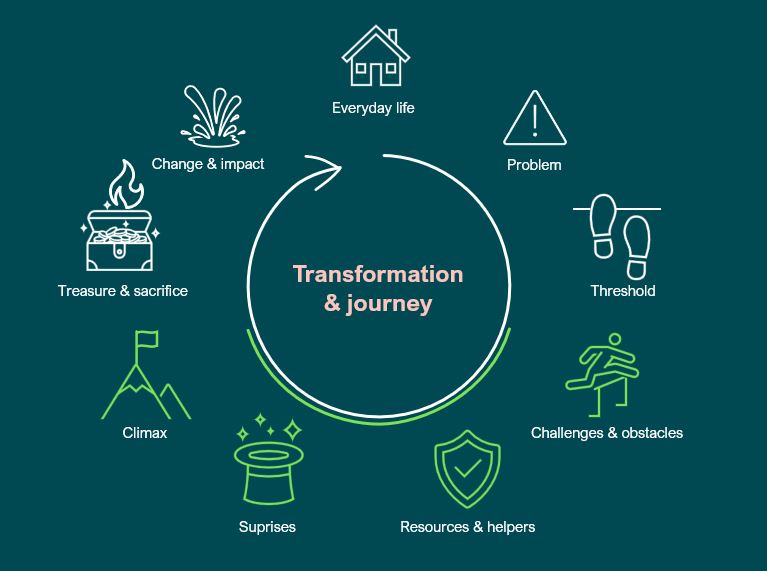
Take a car purchase journey. We could start by asking insight community members to tell the story of buying their new car, from their first thoughts through to the actual purchase.
We could then use the Hero’s Journey framework to explore their stories in more depth. We might explore:
- The problem: What wasn’t working with their old car?
- The threshold: What stopped them from buying immediately?
- The journey: What did they experience while searching for a new car?
- Challenges: What obstacles did they encounter?
- Resources and helpers: Who or what helped them along the way?
- Treasure: What are the three best things about owning their new car?
- Sacrifice: What did they give up to make the purchase?
- Change and impact: How has the new car changed their life?
Combining free and prompted storytelling allows us to explore both visible and less obvious elements of people’s experiences. It captures context and meaning while revealing the role that brands, products and touchpoints play in people’s lives.
Get to the inside story: humanise data
Stories are data with a soul.
Instead of dry statistics and isolated answers, narratives give us a more contextualised view of people’s lives and experiences. They make research findings more memorable and easier to share across organisations. A powerful narrative can bring insights to life, build empathy and point to clear paths to action. It helps bridge the gap between data and decisions by putting people at the centre of the story.
For one client, we brought the results of a research study to life through large interactive displays at an annual internal conference. Attendees could physically interact with the data and discuss it with colleagues as part of an active learning experience. The conference had a Space theme, so we turned the findings into ‘Data Planets’ and ‘Space Stations’. At an ‘Alien Voices’ audio station, attendees could scan a QR code with their mobile phones to hear real customer quotes.
For one of our finance clients, we also brought the experiences of Hong Kong banking consumers to life through infographics. But data and infographics alone don’t necessarily create a memorable story. We structured the findings around a storytelling framework to create a narrative that made the insights easier to understand and connect with.
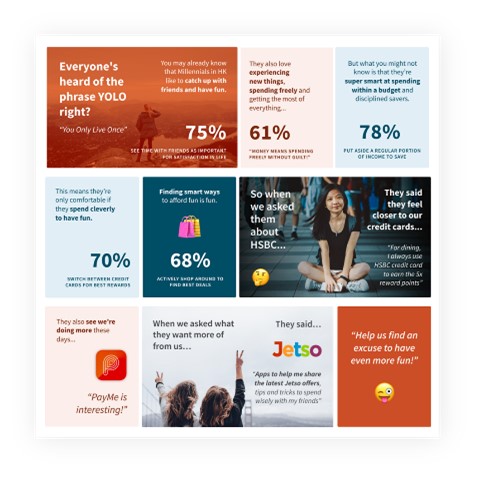
Storytelling has great potential to move from facts to feelings, from data to decisions. It’s not only a powerful way to activate insights, but also an effective research technique to tap into people’s unconscious mind.
FAQs
1. What is human-centred research?
Human-centred research puts people’s experiences, needs, motivations and context at the heart of the research process. It aims to understand people beyond isolated behaviours or answers.
2. Why is human-centred research important?
It helps organisations build a deeper understanding of the people they are designing products, services and experiences for. This can lead to more relevant insights and better-informed decisions.
3. How can storytelling be used in research?
Storytelling can be used to encourage people to describe experiences in their own words. Researchers can combine free storytelling with creative prompts or structured frameworks to explore specific moments, emotions and motivations in greater depth.
4. How do you analyse storytelling research?
Researchers look beyond individual statements to identify recurring themes, behaviours, emotions, motivations and moments that shape people’s experiences. These findings can then be combined with other research data to build a broader picture.
5. How is human-centred research different from user research?
User research typically focuses on understanding how people interact with a specific product, service or experience. Human-centred research takes a broader view, exploring people’s needs, behaviours, motivations and context beyond a single user interaction.