The art of simulation: six principles for creating digital twins that reflect real human behaviour
Why better simulations start with the right questions, the right consumers and the right context.

Annelies Verhaeghe
04 August 2026
10 min read
Digital twins are AI-based consumer simulations that can support brands with innovation, branding and CX challenges. Their value depends on six key principles: defining the right decision, representing the right consumers, choosing the right simulation, building context, asking human-centred questions and interpreting outputs carefully.
Digital twins are opening exciting new possibilities for consumer understanding. Built on existing consumer research and data, digital twins are AI-based representations of consumers that allow organisations to explore perspectives, test ideas and simulate different scenarios without having to start every research project from scratch. They can help teams understand how different consumers might react to a new concept, explore unmet needs or challenge assumptions before making important decisions.
But there is a common misconception: that digital twins simply give you answers. In reality, the quality of the output depends on the quality of the design behind it. Defining the right decision, representing the right consumers, choosing the right simulation, creating meaningful context, asking human-centred questions and interpreting outputs carefully all influence what you learn.
In other words, simulation is an art. Here are six principles to keep in mind when experimenting with digital twins or choosing a partner to work with.
1. Start with the decision, not the digital twin
It’s tempting to begin with the technology: “What can we ask our digital twins?” The better question is: “What decision are we trying to make?”
Digital twins are not the starting point. They are a tool to support a decision. Whether you’re exploring unmet needs, testing a concept, improving an experience or preparing for future scenarios, your objective should guide every choice that follows.
This matters because different objectives require different approaches. The questions you ask, the consumers you represent and the simulations you design should all be shaped by what you’re ultimately trying to learn.
For example, a team looking to understand why consumers are leaving a category will need a very different approach from a team exploring reactions to a new product concept. The technology may be the same, but the research design not.
Before building or commissioning a simulation, take a step back and define the decision you’re trying to support. The clearer the objective, the more valuable the insights will be.
The takeaway: Digital twins should start with a business question, not a technology question. Define the decision first, then design the simulation around it.
2. Represent the right consumers
Once you’ve defined the decision, the next question is simple: whose perspective do you need to understand?
Are you trying to understand young families entering a new category? People who have switched to competitors? Early adopters versus mainstream consumers? The more specific your audience definition, the more meaningful the simulation becomes.
This is where digital twins differ from traditional personas. Personas are useful summaries of groups. They help organisations align around a target audience. But they often describe the “average” consumer: “Catherine, 38, busy mother, values convenience and sustainability.” A digital twin goes one step further. It represents an individual consumer with their own combination of behaviours, motivations, experiences and circumstances. That individual foundation allows organisations to move beyond asking, “What does this audience think?” and explore, “How might different people within this audience respond?”
Research by Ariane Rocha and colleagues illustrates why this matters. In their study, the team compared real families with AI-generated versions of those same families, exploring whether synthetic consumers could replicate real decision-making, spending habits and perspectives. The research showed that digital twins can produce realistic responses, but only when they are grounded in the right information. One example involved an 86-year-old grandmother from Lima, Peru. The real grandmother expressed fears about her children leaving home and the possibility of ageing alone. Her AI-generated counterpart responded in a much more generic way, describing the situation as a challenge she would face with pride. The simulation had created a believable person. But it wasn’t the right person.
The lesson is important: realism is not the same as accuracy. Digital twins can produce convincing responses, but only when they are grounded in the right consumer understanding. A good digital twin is not about creating the most human-sounding AI. It is about representing the right human reality.
The takeaway: A simulation is only as valuable as the consumers it represents. Make sure you’re learning from the right people before worrying about the technology.
3. Choose the simulation that matches the decision
Once you’ve defined the decision and the consumers you want to understand, the next step is deciding how to learn from them.
A common misconception is that working with digital twins simply means asking a question and receiving an answer. In reality, different business objectives require different types of simulations.
Exploring needs and tensions
When the goal is understanding, start with exploration. Instead of asking consumers to react to an idea, explore the realities that shape their behaviour. Rather than: “Do you like this product idea?” ask: “What challenges do you face when trying to make healthier choices for your family?”
This helps uncover motivations and unmet needs before introducing solutions.
Testing and refining concepts
Concept simulations allow teams to test and refine ideas long before they reach consumers. Rather than validating a finished concept, organisations can use simulations to identify what sparks interest, what feels irrelevant and where opportunities for improvement exist. This creates a faster learning loop in which ideas can be explored, refined and challenged before real-world testing.
Of course, digital twins don’t replace validation with real consumers for high-stakes decisions. Their value lies in helping teams make better decisions earlier.
Understanding trade-offs
Real consumer decisions rarely happen in isolation. People constantly balance competing priorities: price versus quality, convenience versus sustainability or speed versus personalised service. Choice simulations introduce these kinds of trade-offs into the environment. Instead of asking whether someone likes an option, they explore what people would choose when faced with realistic constraints. This often produces more meaningful insights than simple preference questions.
Exploring possible futures
Most research looks at today’s reality. But organisations increasingly need to prepare for situations that do not exist yet.
How might consumers behave if AI assistants become the main shopping interface? What happens if economic pressures increase? How could changing regulations influence everyday choices?
Scenario simulations allow organisations to place consumers into different possible futures and explore how needs, behaviours and priorities might evolve. The goal isn’t to predict the future. It’s to better prepare for it.
The next frontier: from words to behaviour
Today, most digital twins simulate what consumers might say. The next evolution is understanding what they might do.
Behavioural simulations seek to model decisions and actions within dynamic environments. For example, instead of asking consumers what they think about a website or app experience, behavioural simulations can place digital twins inside that experience and observe how they navigate it. This shifts the focus from stated opinions to simulated behaviour, bringing research one step closer to real-world decision-making.
In summary, there is no single way to work with digital twins. The best simulation is not the most sophisticated one. It is the one that best matches the decision you’re trying to support.
The takeaway: Different decisions require different simulations. Choose the method that best fits what you’re trying to learn.
4. Context is what turns an answer into an insight
One of the biggest differences between humans and AI is context. Consumers never make decisions in isolation. Their mood, previous experiences, routines and environment influence how they respond. Digital twins need the same context.
Imagine asking: “What do you think about this meal-planning app?” Now imagine first asking: “Tell me about weekday evenings in your household. What tends to be stressful? What takes up most of your time?” Only then introducing the concept. The second approach creates a richer environment. It activates the routines, frustrations and trade-offs that influence real decisions. The concept has not changed, but the context has. This is why simulation design matters.
Context is shaped throughout the interaction: by the information people receive, the order in which questions are asked, the scenarios they are placed in and even the conversation that happens beforehand. Every element helps create the lens through which consumers evaluate an idea.
Even small changes can create different outcomes. For example, a consumer evaluating a premium product may respond differently if they have first discussed financial pressures. A sustainability message may land differently after a conversation about convenience and time constraints. The concept hasn’t changed, but the context has. The goal of a good simulation is not simply to generate an answer. It’s to recreate the conditions in which real decisions are made. Because context doesn’t just influence responses, it helps create them.
The takeaway: Consumer reactions don’t happen in a vacuum. Build realistic context if you want realistic responses.
5. Digital twins answer what you ask, not what you mean to ask
Even in a well-designed simulation with realistic context, the quality of the outcome still depends on the questions you ask. That’s because digital twins don’t interpret intent the way humans do. They respond to the language you give them.
A useful way to think about AI is not as a mind that understands meaning, but as a landscape of concepts, associations and patterns. Every prompt acts like a parachute, landing somewhere within that landscape. Depending on where it lands, different ideas and associations become activated.
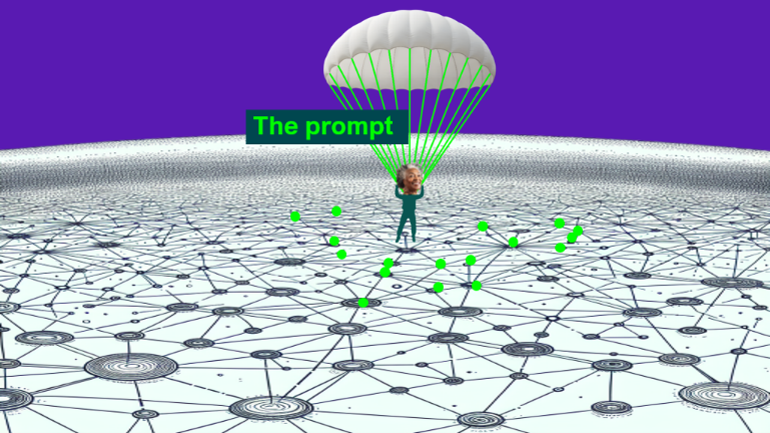
Take a simple example. Ask an AI: “On Sunday, my kids will…” The response may naturally move towards familiar associations: playing, going to the park, spending time with friends. Now add context: “On Sunday, my kids in France will…” The response may shift towards different associations: enjoying a long family lunch, visiting a local market or local traditions. Change the country and the answer changes again. The model is not experiencing culture like a person does. It is drawing on patterns from the information it has learned. This matters because language shapes the reality you create in a simulation.
When organisations work with digital twins, they often start with a business question. They ask about purchase barriers, conversion rates or whether a positioning will drive consideration. But consumers rarely experience their lives through those questions. They are not thinking: “What is my purchase barrier?” They are thinking: “Does this fit into my life?” “Would I trust this?” “Does this solve a problem I actually have?”
A question like “What is the purchase barrier?” already frames someone as a consumer evaluating a transaction. A question like “What made you hesitate?” or “What is holding you back?” gets much closer to the human experience behind that decision.
The goal is not simply to ask digital twins questions. The goal is to ask questions that reflect human reality. That’s where research expertise remains essential. Successful simulations require more than prompt-writing skills. They require a deep understanding of the language, emotions, tensions and contexts that shape real consumer behaviour. Because digital twins don’t interpret what you meant to ask. They answer the question you actually asked.
The takeaway: Digital twins answer the question you ask, not the one you intended. Human-centred questions produce more meaningful insights.
6. Seeing isn’t the same as interpreting
Visual stimuli require a different approach to simulation. One common mistake is assuming AI processes visuals in the same way humans do. Give an AI model an image and it can often describe it in impressive detail: the colours, objects and composition. But that’s not how most consumers experience visuals. People do not analyse every element equally. They notice what stands out, form impressions and attach personal, cultural and emotional meaning to what they see. In other words: consumers don’t simply see an image, they interpret it.
That’s why visual simulations require particular care. A package design, advertisement or brand visual is never just a combination of colours and objects. It creates associations, signals meaning and evokes feelings. And those reactions are often shaped by brand familiarity, category expectations and cultural context.
When evaluating a new packaging design, for example, the goal should not be to understand what consumers literally see. The more important question is what meaning they take from it.
This means that visual testing often benefits from being structured in stages. Teams might first explore reactions to a concept, then introduce branding, imagery, colours or different executions to understand what is shaping the response.
The goal is not simply to evaluate whether a digital twin can describe a visual accurately. The goal is to understand how consumers are likely to interpret it. Because ultimately, brands are not judged by what people see. They’re judged by what people take away from what they see.
The takeaway: Don’t stop at what a digital twin sees or says. Focus on what the response means for consumer behaviour and brand decisions.
Digital twins aren’t a shortcut. They’re a new research instrument.
The biggest mistake organisations can make is treating digital twins as a shortcut to consumer understanding. They are not. They are a powerful new research instrument.
But like any instrument, they require expertise. The strongest simulations combine a clear business objective, the right consumer representation, an appropriate simulation design, meaningful context, thoughtful question design and careful interpretation. Technology matters, but it is only one part of the equation. The quality of the simulation ultimately depends on the quality of the thinking behind it.
These six principles will help ensure you’re learning from digital twins in a way that is grounded in consumer reality rather than technological novelty.
So when choosing a digital twin partner, don’t just ask: “How powerful is your AI model?” Ask how they design simulations, how they define and represent consumers, how they validate outputs and when they recommend speaking with real consumers instead.
Technology is only one part of the equation. Great simulations come from combining the right tools with deep consumer understanding, research expertise and thoughtful design. Because the future of digital twins is not about replacing human understanding. It’s about scaling it. And like any art, great simulations are not defined by the tool itself, but by the expertise behind it.
FAQS
1. What is a digital twin in consumer research?
A digital twin is an AI-based representation of a consumer grounded in research, that can be used to explore reactions, simulate conversations and test scenarios.
2. Can digital twins replace traditional consumer research?
No. Digital twins are a complementary research tool. They can help organisations explore ideas faster, identify patterns and prepare for decisions, but high-stakes decisions still benefit from validation with real consumers.
3. What makes a digital twin accurate?
The quality of a digital twin depends on the quality of the foundation behind it. The data used, the consumers represented, the questions asked, the simulation design and the interpretation of results all influence how meaningful the output will be.
4. What are the biggest mistakes when using digital twins?
Common mistakes include asking vague or business-focused questions, simulating the wrong audience, ignoring context and treating AI-generated responses as objective truths rather than signals that require interpretation.