Breaking the bubble: why consumer empathy matters more than ever
As distance grows between decision-makers and consumers, consumer empathy becomes a key mechanism to challenge internal bias and bring organisations closer to lived reality.

Sarah Van Oerle
21 May 2026
7 min read
Organisational bias creates a disconnect between brands and consumers. We show how consumer empathy helps decision-makers close that gap by reconnecting with real-world behaviour, context and lived experience.
You don’t see the world as it is, you see it as you are. As a consequence, brand decisions are not made in isolation. They are shaped by the context of marketers; the places where they live, work and absorb culture. Research in Australia highlights how concentrated those environments can be: a study found that 41% of Sydney agency employees live in the city or inner city, compared to just 4% of the general public. It illustrates a broader pattern seen across creative and marketing industries: these people often cluster in similar urban and cultural environments.
This doesn’t mean marketers lack awareness of consumers. It means their everyday context inevitably influences what feels normal, relevant or ‘true’. And when most inputs come from a similar environment, it becomes harder not to use that environment as an implicit reference point: Would this resonate here? Does this feel right in my world?
It feels logical. Even efficient. But this is where distance can quietly begin to form between decision-makers and the people they are trying to reach.
In our previous blog, we explored how this gap is reinforced by empathy deficit and empathy fatigue. In this piece, we zoom in on a deeper structural layer: the cognitive biases and organisational dynamics that make it easy to believe we understand consumers better than we actually do. And why consumer empathy is so critical to counterbalance that.
The invisible bubble shaping brand decisions
The gap between marketers and consumers is rarely intentional. It is structural.
Organisations tend to concentrate talent in similar environments, attract comparable profiles and reward aligned ways of thinking. In practice, this means that ideas that “feel right” in the room tend to move forward faster, while ideas that challenge dominant assumptions often require significantly more justification.
This is one of the core mechanisms behind organisational bias: what resonates internally is assumed to resonate externally too. Over time, this creates a shared frame of reference, a common sense of what is relevant, desirable or normal. But this frame is not neutral. It reflects a specific and relatively narrow part of society. And the further that perspective drifts from the broader population, the higher the risk that decisions are shaped by internal logic rather than external reality.
A good example is the backlash around a campaign by Poppi, the trendy prebiotic soda brand. To promote the brand, vending machines stocked with Poppi products were sent to influencers as part of a social-first activation. Internally, the idea likely made complete sense: highly visible creators, strong online reach and a format designed to generate attention and engagement. But outside that marketing and influencer ecosystem, the reaction was very different. Many consumers saw the campaign as wasteful, excessive and disconnected from everyday reality, particularly during a period marked by rising living costs and growing sensitivity around overconsumption.
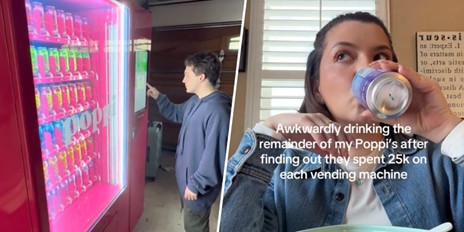
Inside the marketing bubble, the campaign likely felt completely normal. But outside of it, many people experienced it as tone-deaf. And that is exactly how organisational bubbles work: the further teams move away from the lived reality of the people they serve, the harder it becomes to recognise the disconnect.
Why organisational bubbles are so hard to recognise
The difficult part is that these bubbles rarely feel like bubbles from the inside. Living in one is not a flaw, it is human nature. We naturally gravitate towards people who are similar to us. In friendships, workplaces and even the media we consume. Sociologists call this homophily: similarity breeds connection. Inside organisations, this creates smoother collaboration and faster decision-making. But it also narrows perspective.
And once a certain worldview becomes dominant internally, several cognitive biases start reinforcing it further. Think about ‘confirmation bias’: our tendency to interpret new information in ways that support what we already believe. In practice, this can make marketers overvalue insights that fit existing assumptions, while dismissing signals that challenge them. Or take the ‘sunk cost fallacy’, which makes organisations continue investing in ideas simply because time, money or energy has already been committed to them.
As author Harper Lee once wrote in ‘To Kill a Mockingbird’: “People generally see what they look for and hear what they listen for.” That is exactly what makes organisational bubbles so difficult to recognise from the inside. The more a perspective is repeated and validated internally, the more natural and objective it starts to feel. And slowly, internal agreement starts to become a substitute for external truth. What feels right inside the organisation increasingly defines what is assumed to be right outside of it.
Closing the distance between brand and people
When organisations rely too heavily on internal reference points, distance starts to form. Decision-makers interpret consumer behaviour through their own lens. But consumer reality is not uniform. Context shapes everything. What appears obvious to one group may feel irrelevant to another. What seems like a small detail internally can carry significant meaning externally.
This is where the empathy gap emerges: the difficulty of fully understanding how people think, feel and behave when you are not living their reality. And this is exactly where consumer empathy becomes essential.
Recognising this gap is only a starting point. Yet, the more important shift happens when organisations actively design against it. That means challenging internal consensus instead of reinforcing it. Actively seeking perspectives that disrupt dominant assumptions. And staying in regular contact with real consumer reality. Not through dashboards or summaries, but through direct exposure to people’s lives. This is where consumer empathy stops being an abstract concept and becomes a practical capability.
Because empathy is often misunderstood inside organisations. It is seen as a soft layer on top of data, rather than something strategic. But in reality, empathy works more like a corrective mechanism. It helps counterbalance the biases that naturally emerge when people make decisions from within the same environment. It challenges projection, interrupts internal echo chambers and it reconnects organisations with the reality they are trying to serve.
And as the distance between organisations and consumers continues to grow, the ability to actively close that gap becomes critical to better decision-making. Not by knowing more about consumers in theory, but by getting closer to them in reality. That shift from interpretation to proximity is where real change happens. Because when teams are exposed to the contexts people actually live in, something fundamental starts to shift. Decisions become less abstract. Assumptions become easier to question. And consumers stop being segments on a slide and start becoming real people again.
Consumer empathy in action
At Haleon, for example, we designed a Consumer Connect program to move teams beyond reports and into real consumer contexts. Instead of interpreting behaviour from a distance, teams engaged directly with people in their homes and daily environments. They observed routines, listened to lived experiences and connected the dots between behaviour, motivation and context. What changed was not just the quality of insight, but the quality of decisions that followed. Consumers became real again, not abstract segments. And with that, assumptions were challenged much earlier in the process.
A similar shift happened at Heineken through a more systematic focus on consumer-centric thinking across the organisation. Rather than treating consumer understanding as a one-off input at the start of innovation, we helped Heineken embed it across decision-making moments. Teams are encouraged to continuously reconnect with consumer reality throughout development and strategy work. This ongoing exposure helps reduce internal bias, sharpen relevance and ensure that ideas are not only strong in theory, but meaningful in the contexts where they need to land.
In both cases, the effect is the same. When organisations move closer to real people and real contexts, decisions change. Not because the data changes, but because the perspective does.
And that is where consumer empathy becomes most powerful. Not as sentiment, but as structural approach. As a way of working that reduces distance, challenges assumptions and keeps organisations grounded in the realities they are trying to serve.
FAQS
1. What is consumer empathy?
Consumer empathy is the ability to deeply understand and relate to people’s lived experiences, contexts and emotions. It goes beyond analysing consumer insights by stepping into real situations, enabling decision-makers to interpret behaviour more accurately and make more human-centred decisions.
2. Why do brands and marketers operate in a “bubble”?
Brands and marketers often operate in a bubble because organisational structures, hiring patterns and shared environments lead to similar thinking. Over time, this creates internal alignment that can unintentionally replace exposure to diverse consumer realities.
3. How does organisational bias affect brand decision-making?
Organisational bias causes decision-makers to rely on internal perspectives as a proxy for consumer reality. This can lead to assumptions, simplified interpretations of behaviour and strategies that feel right internally but do not always resonate externally.
4. What is the empathy gap in marketing?
The empathy gap in marketing is the disconnect between how decision-makers think consumers behave and how consumers actually behave in real-life contexts. It emerges when brands rely too heavily on internal assumptions instead of lived consumer experience.
5. Why is it difficult for organisations to recognise their own bias?
It is difficult because cognitive biases such as confirmation bias and homophily reinforce shared beliefs within organisations. As a result, internal agreement can feel like external validation, making it hard to see when perspectives are becoming narrow or misaligned.
6. How can organisations improve consumer understanding?
Organisations can improve consumer understanding by actively increasing proximity to real people and contexts. This includes challenging internal consensus, seeking diverse perspectives and embedding direct consumer exposure into decision-making processes rather than relying solely on data or reports.